Monday, March 12, 2018

Hillbarn stages story of 'The Elephant Man'

From left Joshua Marx as John Merrick and Michael Barrett Austin as Frederick Treves. (Photo by Mark and Tracy Photography)

The story of a horribly deformed young man in the late 19th century is dramatized in Bernard Pomerance’s “The Elephant Man,” presented by Hillbarn Theatre.

Though fictionalized, it’s based on a real man, John Merrick (Joshua Marx), who suffered from neurofibromatosis, a debilitating condition that didn’t have a name or cure then.

Mocked and mistreated, John was part of a freak show until he was discovered by Dr. Frederick Treves (Michael Barrett Austin), an anatomical lecturer and rising young surgeon at a London hospital.

The play begins with Treves showing photos of the actual John Merrick, who had bulging growths all over his body. His right hand was useless, one eye was almost closed and his head was so swollen and misshapen that he couldn’t lie flat to sleep.

Treves rescued him and took him to live at the hospital, where he was well treated and could exercise his considerable intellect. At one point, John says, “My head is so big because it’s full of dreams.”

He became the darling of London socialites and royals, who donated money for his lifetime care.

Religion became important to him as he designed and then built a model for St. Philip’s Church.

His life was brightened by the arrival of Mrs. Kendal (Stephanie Maysonave), with whom he discussed what he was reading, such as “Romeo and Juliet.”

As their friendship developed, he confessed that he had never seen a naked woman. She obliges by baring her breasts. However, this tender moment is interrupted by Treves, who orders her to leave and never return.

Pomerance’s script has shortcomings. For example, it doesn’t make clear why Treves was being swindled by Lord John (Rich Matli). It’s also episodic.

Direction by Jasen Jeffrey does nothing to eliminate that effect, and it doesn’t make some of the characters particularly involving despite some good performances.

Likewise, the barebones set by Ting Na Wang does little to advance the drama. In particular, the model of the church was an important symbol in previous productions, but here it’s like an afterthought.

Nevertheless, Marx does a good job of transforming himself into John without resorting to makeup to become convincing.

Austin’s performance as Treves works well for the most part except toward the end, when he seems to suffer a crisis of faith. Maysonave remains too actressy as Mrs. Kendal.

Several other members of the ensemble are noteworthy, especially John Musgrave as Carr Gomm, the hospital administrator, and Thomas Cokenias in contrasting roles as Ross, the heartless  freak show manager, and as the bishop who becomes John’s spiritual adviser.

Lighting by Pamila Gray enhances the drama, but a footlight in front of an aisle is a tripping hazard.

Running about two hours with one intermission, “The Elephant Man” will continue through March 25 at Hillbarn Theatre, 1285 E. Hillsdale Blvd., Foster City. For tickets and information, call (650) 349-6411, Ext. 2, or visit www.hillbarntheatre.org.


'Skeleton Crew' improves in move to TheatreWorks

Tristan Cunningham (left) is Shanita and Margo Hall is Faye in "Skeleton Crew." (Photo by Kevin Berne)

TheatreWorks Silicon Valley audiences are the beneficiaries of its co-production of Dominque Morisseau’s “Skeleton Crew.”

When it opened at Marin Theatre Company on Jan. 30, it had some problems, mainly that some lines were spoken too fast to be understood.

That issue has largely disappeared now that the cast has had a chance to iron things out. 

Thus the show has coalesced into a drama where characters and plot subtleties are more clearly drawn. It’s funnier and more touching.

Set in the break room of Detroit’s last auto stamping plant in 2008, the action focuses on how the plant’s possible closure affects four valuable black employees.

One of them is the pregnant, unmarried Shanita (Tristan Cunningham), who finds her work rewarding but worries about how she will care for her child if she loses her job.

The secretive, sullen Dez (Christian Thompson), whose flirtations she rejects, hopes to save enough money to open his own auto shop.

Their union steward, Faye (Margo Hall), is the eldest and wisest. With 29 years on the job, she wants to stay until she’s logged 30 years, entitling her to a better pension and 
benefits.

Finally there’s their foreman, Reggie (Lance Gardner), who wants to continue supporting his wife and family and who’s torn between helping the workers and appeasing management.

Faye underpins all of them. As embodied by Hall, she’s resilient and wise with the ability to say the right thing, whether humorous or stern, to defuse situations.

She and Reggie have a longstanding connection that’s gradually revealed and that influences how they deal with increasingly challenging circumstances.

As so well directed by Jade King Carroll, the actors create characters that one comes to care about, even Dez, who’s not very likable at first.

The effective design elements are the same as in Marin with a set by Ed Haynes, costumes by Callie Floor, lighting by Steven B. Mannshardt, sound by Karin Graybash and projections by Mike Post.

Running about two hours with one intermission, “Skeleton Crew” is an affecting look at the toll that changes in the American manufacturing sector make on real people.

It will continue through April 1 at the Lucie Stern Theatre, 1305 Middlefield Road, Palo Alto. For tickets and information, call (650) 463-1960 or visit www.theatreworks.org.


Saturday, March 10, 2018

Vietnamese refugees adjust to U.S. in 'Vietgone' at ACT

Tong (Jenelle Chu, left) and her mother, Huong (Cindy Im), settle into their Fort Chaffee, Ark., room.

In Qui Nguyen’s “Vietgone,” Vietnamese refugees find themselves in a camp in Fort Chaffee, Ark., after escaping with just their lives in 1975.

In this production by American Conservatory Theater, Quang (James Seol), a South Vietnamese military helicopter pilot who rescued numerous countrymen, wants nothing more than to return to his wife and two children in Vietnam.

Tong (Jenelle Chu), whose beloved younger brother refused to go because of his girlfriend, seems resolved to becoming Americanized. Her mother, Huong (Cindy Im), would rather be back in Vietnam.

Hoping to catch a Navy boat back to Vietnam, Quang and his buddy, Nhan (Stephen Hu), set off on a cross-country motorcycle trip to California.

Tong has an idea for Quang (James Seol). 
Before that, however, Quang and Tong become sexually involved despite his being married, much to her mother’s disapproval.

In the stronger second act, Quang’s friend Nhan becomes pivotal to the story when he convinces Quang that going back to Vietnam would be hopeless and that he should follow his heart by returning to Tong.

Likewise, Tong’s mother convinces her to follow her heart and give in to her love for Quang.

That’s the bare outline of this presentation of the story of the playwright’s parents, Quang and Tong.
Its action shifts back and forth as the characters undergo various experiences over several decades. 

During their motorcycle trip, Quang and Nhan encounter an assortment of characters played by Im as the other women and by Hu and Jomar Tagatac as the other men.

All of this would be just fine if it weren’t for the often unrelenting torrent of profanities and occasional loud raps, which some viewers might find offensive or offputting at worst and unnecessary at best.

Otherwise, it’s an interesting, human-focused look at some little known fallout from the country’s most unpopular war.

Directed by Jaime Castañeda and billed as a road-trip comedy, the play is well acted. The two-level set by Brian Sidney Bembridge with projections by Chris Lundahl is simple but flexible.

Also effective are the lighting by Wen-Ling Liao and costumes by Jessie Amoroso. However, the sound by Jake Rodriguez and music by Shammy Dee are sometimes too loud.

Running about two hours and 20 minutes with one intermission, “Vietgone” will continue through April 22 at ACT’s Strand Theater, 1127 Market St., San Francisco.
For tickets and information, call (415) 749-2228 or visit www.act-sf.org.

Photos by Kevin Berne


Friday, March 9, 2018

Multiple scary outcomes in 'Office Hour'

Dennis (Daniel Chung) arrives for his conference. (Photo by Kevin Berne)

In the wake of the recent school shooting in Florida, Julia Cho’s “Office Hour” couldn’t be more timely.

Presented by Berkeley Repertory Theatre, it focuses on a creative writing college student, Dennis (Daniel Chung), who could be the poster boy for mass murderers, and on a concerned instructor, Gina (Jackie Chung), desperately trying to break through his hostility.

We hear about him before we see him as two of his previous instructors, David (Jeremy Kahn) and Genevieve (Kerry Warren), describe his behavior and his frightening writing.

They’re trying to warn Gina, but she seems to think there’s some hope.

That hope seems misguided when Dennis arrives at her office (set by Matt Saunders) for a required 20-minute conference. Dressed all in black (costumes by Maggie Morgan) with dark sunglasses, baseball cap and hoodie hiding most of his face, he’s scary.

During their meeting, several scenes illustrate possible outcomes, all of them scary or even deadly, that take place in her imagination. After each one, their encounter resumes as if nothing had changed.

Although she gradually gets this loner to open up about how he was bullied and how much he hates, Gina also reveals much about herself. Perhaps there’s a rapport between them because they’re both first-generation Asian American.

In one of the more amusing scenes, she gets him to pretend she is his mother talking to him on the phone.

The ending, or rather series of possible endings with all four characters, is chaotic. Lighting by Scott Zielinski and music and sound by Robert Kaplowitz enhance the effects.

This co-production with Long Wharf Theatre of Connecticut is crisply directed by Lisa Peterson. 

Despite its tendency toward talkiness, it maintains one’s attention.

Running a taut 80 minutes with no intermission, it will continue through March 25 in Berkeley Rep’s Peet’s Theatre, 2025 Addison St., Berkeley. For tickets and information, call (510) 647-2949 or visit www.berkeleyrep.org/

Tuesday, March 6, 2018

Fed up with sexism, women take over in '9 to 5 The Musical"

 Allie Townsend as Doralee (left), Glenna Murillo as Violet and Rachelle Abbey as Judy commiserate. (David Allen photo)

If working women bucked the old-boy network and ran the office, they’d be a lot better off. That’s what happens in “9 to 5 The Musical,” presented by Foothill Music Theatre.

With music and lyrics by Dolly Parton and a book by Patricia Resnick, this timely, entertaining show premiered in 2008 and was based on the 1980 film starring Parton, Lily Tomlin and Jane Fonda.

It takes place in 1979 at company led by Franklin Hart (Aaron Hurley). He treats female employees, especially the young, attractive ones, like sex objects, calls them girls and makes them fetch his coffee. A woman who discovers that she’s being paid less than a man doing the same job is fired.

Fed up with his behavior, three of the women conspire to hide him for a few weeks, fake memos from him and institute much-needed changes. Soon everyone is better off.

The women are led by Violet (Glenna Murillo in the Tomlin role), a widow with a teenage son.

Her cohorts are the young, newly hired Judy (Rachelle Abbey in the Fonda role), who’s recently divorced, and the sexy but happily married Doralee (Allie Townsend in the Parton role). Doralee has to fend off the boss the most.

All three of these women do well. Also noteworthy is Angela Cesena as Roz, the administrative assistant who’s Hart’s spy and who has a crush on him. She has a standout number, “Heart to Hart,” in which she tells how much she loves him.

The supporting characters and ensemble are strong, with kudos going to Kayvon Kordestani as Margaret, the office drunk who benefits from the new rehab benefit.

Parton’s songs have a distinctively country twang, and they’re performed well under the musical direction of Dolores Duran-Cefalu, who leads four instrumentalists from the keyboard.

The show is crisply directed by Milissa Carey with lively choreography by Claire Alexander. The flexible set is by Christopher Fitzer, the attractive costumes by Chiara Cola and sound by Andrew Heller. Keenan Molner’s lighting is sometimes too dim.

Although the show glosses over some plot lines like Hart’s cooking the books and makes light of his unwanted sexual advances – especially in this #MeToo era -- overall it’s timely and, most of all, lots of fun.

Running about two and a half hours with one intermission, it will continue through March 18 in the Lohman Theatre, Foothill College, 12345 El Monte Road, Los Altos Hills.

For tickets and information, call (650) 949-7360 or visit https://foothill.edu/theatre/productions/9to5.html.


Wednesday, February 14, 2018

'Sweeney Todd' retains power at San Jose Stage

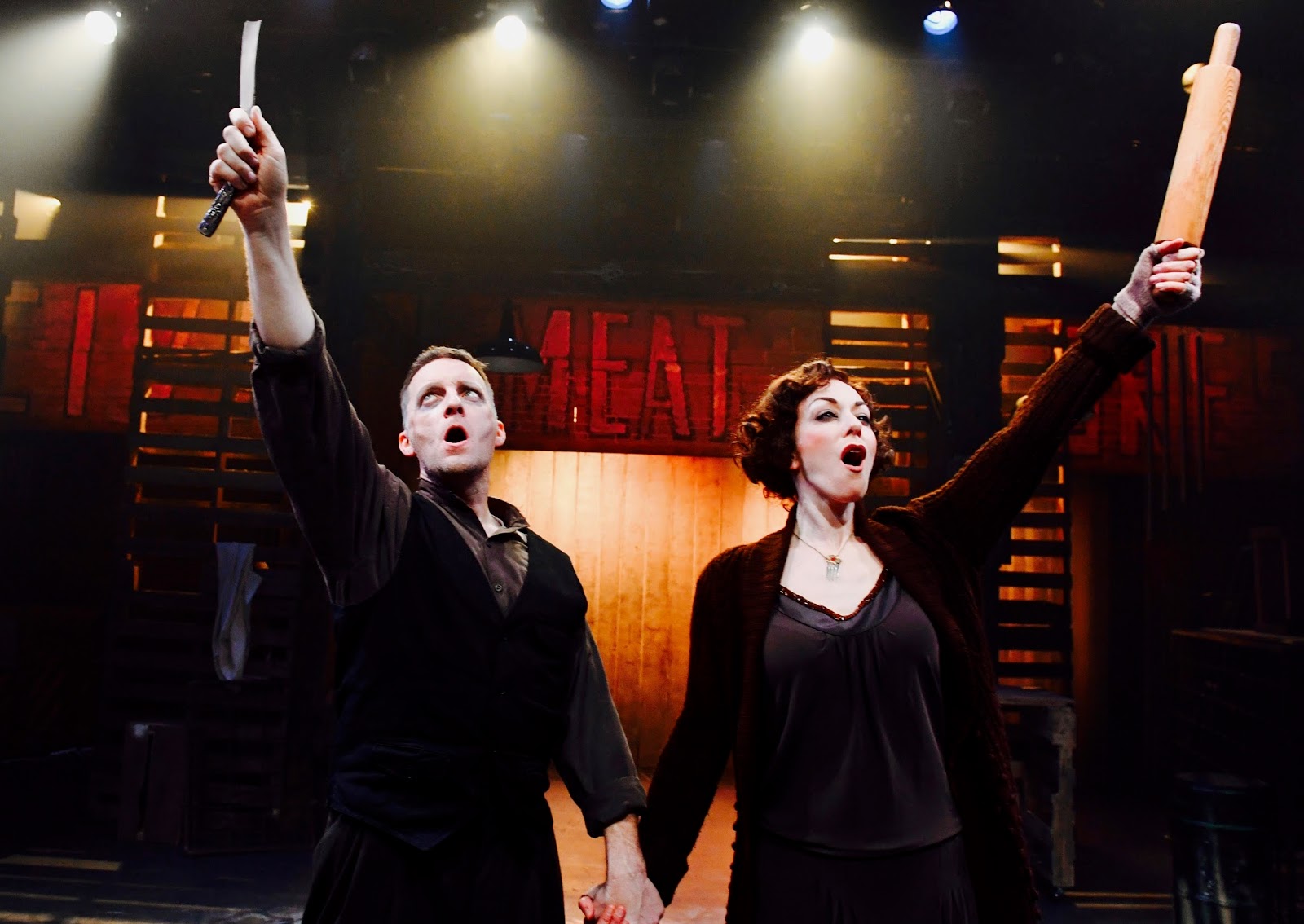
Noel Anthony as Sweeney Todd and Allison F. Rich as Mrs. Lovett (Photo by Dave Lepori)

Proof that Stephen Sondheim’s “Sweeney Todd: The Demon Barber of Fleet Street” is the work of a genius lies with San Jose Stage Company’s production.

Winner of eight Tony Awards, this 1979 tale of a wronged barber’s revenge has seen on stages from Broadway to community theaters. Both the San Francisco Opera and San Francisco Symphony have presented it.

Although the show is traditionally set in Victorian London, this production appears to be in the late ‘20s or early ‘30s, judging by Abra Berman’s costumes. Director Kenneth Kelleher uses only 10 actors.

Although many productions have used a more expansive, two-level stage, scenic and lighting designer Michael Palumbo (sound by Steve Schoenbeck) compresses the action into the venue’s small, one-level space. It works because of his design and Kelleher’s ingenious staging.

While the book by Hugh Wheeler has intrinsic interest, Sondheim’s music and clever lyrics carry the show – provided they have actors who can handle them.

This production has them, starting with Noel Anthony as the haunted Sweeney Todd, who returns to London after being sent to an Australian prison by a crooked judge with designs on Sweeney’s wife.

He’s balanced by Allison F. Rich as Mrs. Lovett, who runs a shop making “The Worst Pies in London.” She becomes Sweeney’s accomplice and would-be sweetheart. It’s a mainly comical role illustrated in songs like “By the Sea.”

Sam Faustine takes on the vocally challenging role of Anthony Hope, the sailor who has befriended Sweeney. By coincidence, he sees Sweeney’s daughter, immediately falls in love with her and sings the show’s most beautiful song, “Johanna,” in a sweet, light tenor.

Johanna, the object of his affection, is played by Monique Hafen. Her voice becomes too shrill in her coloratura “Green Finch and Linnet Bird.”

Supporting roles are all excellent, starting with Keith Pinto as Tobias Ragg, the disabled boy who becomes Mrs. Lovett’s assistant when her pie shop starts to thrive, thanks to grisly contributions by Sweeney.

Christopher Vettel plays Judge Turpin, who has adopted Johanna. He’s impressive in the often omitted “Mea Culpa,” in which he flagellates himself over his lust for her.

His smarmy henchman, The Beadle, is played by Branden Noel Thomas, while the Beggar Woman is played by Jill Miller. Both do well.

Seated on the side are four musicians, including musical director Katie Coleman on keyboard.

Kelleher has made a few minor omissions, but none subtract from the power of this show.

Running about two and a half hours with one intermission, “Sweeney Todd” will continue through March 18 at San Jose Stage Company, 490 S. First St., San Jose. For tickets and information, call (408) 283-7142 or visit www.thestage.org.


Saturday, February 10, 2018

Relationship evolves over 5 decades in "Reel to Reel"

"Reel to Reel" features, from left, Will Marchetti as Walter 2, Andrew Pastides as Walter 1, Zoë Winters as Maggie 2 and Carla Spindt as Maggie 1. (Photo by Julie Haber)

Maintaining a relationship over many decades often depends on the little things.

That’s one theme of “Reel to Reel,” written and directed by John Kolvenbach and receiving its world premiere at Magic Theatre.

The relationship is between Maggie and Walter, who spend 55 years and three months together. They’re seen mainly when they meet at age 27 and start living together, again at age 42 when they get married, and yet again when they’re both 82 in 2050.

The 82-year-olds are portrayed by Carla Spindt as Maggie 2 and Will Marchetti as Walter 2. Their younger selves are played by Zoë Winters as Maggie 1 and Andrew Pastides as Walter 1.

Maggie has been fascinated by sound nearly all of her life and has recorded hours and hours of it. She painstakingly splices the results into slices of life that she uses in a performance. Walter apparently is a filmmaker, but perhaps not a serious one.

Walter 1 is a nerd who’s dismayed when the bold Maggie 1 marches into his apartment, his bed and his life on the night they first met at a party.

Walter 2 and Maggie 2 have mellowed into a comfortable existence in which each seems content with the other and their small moments.

The couple’s evolution is illustrated in scenes that switch in time, often overlapping.
In addition, the actors portray other characters, such as Walter 1’s friend Betty (Winters) and Maggie 1’s parents (Spindt and Marchetti). They provide an array of sound effects.

Although the actors deliver most of their lines from memory, they sometimes refer to scripts on music stands on either side of the stage. The impression is that this world premiere is in flux, as if last-minute changes are being made.

However, the use of scripts doesn’t distract from the intrinsic interest of the concept and of the action, which Kolvenbach orchestrates well for the most part. The one exception is Winters, who often seems too strident as Maggie 1.  

On the other hand, Pastides as Walter 1 and Spindt and Marchetti as the elder couple all do well. Longtime Bay Area theatergoers may recall that Spindt and Marchetti have often acted together, many times as couples.

Other production values complement the show with the set and projections by Erik Flatmo, costumes by Meg Neville and lighting by Wen-Ling Liao.

Running about 85 minutes with no intermission, “Reel to Reel” will continue through Feb. 25 at the Magic Theatre, Fort Mason Center, 2 Marina Blvd., Building D, San Francisco. For tickets and information, call (415) 441-8822 or visit www.magictheatre.org.