Monday, July 30, 2018

Stanford stages double bill of Greek classics

Courtney Walsh, seen with the chorus, plays Hecuba for Stanford Repertory Theater. (Photo by Frank Chen)

Stanford Repertory Theater is marking its 20th summer festival with an ambitious undertaking by presenting two Greek classics of the fifth century, Euripides’ “Hecuba” and “Helen.”

Artistic director Rush Rehm, who also directs, translated and adapted them from the ancient Greek. The program credits Courtney Walsh, who plays both title roles, also as translator and adapter.

The results are somewhat mixed mainly because the level of acting is mixed. Walsh does well in both roles, but, like some of her colleagues, she sometimes over-acted.

Hence, “Hecuba” sometimes comes across as melodramatic.

However, its plot tends to be interesting because of the intrigue. Hecuba and other Trojan women are slaves after the Greeks conquered Troy and killed nearly all of the men in about 1184 B.C.

Hecuba has already lost her husband, King Priam, and some of her children. Now the Greeks want to sacrifice her daughter Polyxena (Lea Claire Zawada), to honor the slain Achilles.

After Polyxena goes willingly to her death, Hecuba learns that her youngest son, Polydorus (Shayan Hooshmand), has been killed by King Polymnestor of Thrace (Joe Estlack) in a grave violation of the laws of hospitality.

Hecuba and her women exact revenge by killing Polymnestor’s two young sons and blinding him.

As this play ends, Walsh transforms herself from the grieving old Hecuba to the glamorous Helen.

In “Helen,” it’s revealed that a phantom, not Helen, was sent to Troy, sparking war with the Greeks. In the meantime, she has taken refuge in Egypt, where she is reunited with her husband, Menelaus (Estlack).

She uses artifice to allow herself and Menelaus to escape from her host, King Theoclymenus (Doug Nolan), who wants to marry her.

Both plays include a chorus of women who sometimes dance (choreography by Aleta Hayes) and sing (music by sound designer Michael Keck) to propel the action.

The set and costumes by Connie Strayer are relatively simple, but they’re enhanced by Nima Deghani’s projections. Lighting is by Michael Ramsaur.

The production takes place in a black box theater that’s part of Roble Gym, which has been recently renovated for use by the performing arts. 

This courtyard is just outside the Roble StudioTheater. (Stanford photo)
It’s an inviting setting next to a rosemary-scented courtyard with a fountain.

After its Stanford run, the production will be presented Sept. 7-9 in Athens, Greece, featuring Walsh with a Greek cast.

Besides the two plays, SRT’s summer festival, dubbed Nevertheless They Persisted, includes a free Monday night film series, an all-day symposium, and an evening course, “Euripides Our Contemporary,” which began in late June.

Running about two hours and 15 minutes with one intermission, “Hecuba/Helen” continues through Aug. 19 in the Roble Studio Theater, 375 Santa Teresa, Stanford.

For tickets and information, call (650) 725-5838 or visit www.stanfordreptheater.com.


Wednesday, July 25, 2018

Foothill stages timeless 'The Sound of Music'

Maria (Jillian Bader) sets off for her job as a governess for the von Trapp children (Photo by David Allen)

Foothill Music Theatre is staging the timeless and timely “The Sound of Music” and doing a fine job.

Based on the von Trapp family singers, who made their way to the United States from Austria in 1938, the book by Howard Lindsay and Russel Crouse tells a story of love, the pursuit of one’s dreams and the refusal to compromise one’s principles.

To most people, however, it’s a captivating show filled with memorable characters and even more memorable music, thanks to composer Richard Rodgers and lyricist Oscar Hammerstein II.

It’s hard to resist humming along to the title song and classics like “My Favorite Things,” “Do-Re-Mi,” “Climb Ev’ry Mountain” and “Edelweiss.”

The central character is Maria Rainer (Jillian Bader), a would-be nun who loves to sing. Despite her eagerness for the religious life, the Mother Abbess (Rachel Michelberg) sends Maria to the home of retired navy Captain Georg von Trapp (Scott Solomon), a widower whose seven children need a governess.

She finds a household with lots of military precision and little fun. She soon changes all that, mainly through music and the belief that children should be children, not martinets.

Before long, she also softens Georg’s heart and helps him to see how much the children need a loving father. They’re eventually married, much to the children’s delight.

Their happiness is short-lived because fascist Germany is a growing threat. When local Nazis ask Georg to take command of a German ship, he has little choice even though he despises fascism.

However, a singing contest managed by his friend Max Detweiler (Aaron Hurley) offers a chance for the family to escape across the Alps to Switzerland.

The show is ably directed by Milissa Carey, who does especially well with the youngsters, who are double cast except for Madison Colgate as 16-year-old Liesl, the oldest. Choreography is by Brett and C.J. Blankenship.

Music director William Liberatore leads the excellent orchestra and some outstanding choral singing by the nuns and the von Trapp children.

As Maria, Bader combines charm and a likable stage presence with fine singing.
Acting is good throughout the cast, especially the other principals, including Elizabeth 
Claire Lawrence as Elsa Schraeder, Georg’s former fiancĂ©e.

Production values are high with a set by Kuo-Hao Lo, lighting by Michael Ramsaur, sound by Andrew Heller and costumes by Mae Matos and Lisa Rozman.

Extra kudos go to the entire cast for maintaining composure at the first Sunday matinee, when the audience was filled with children, some very young. Hence there were distractions like crying, leaving for the bathroom, talking and fidgeting.

Although seeing a great show like this could benefit children, parents should make sure they know how to behave.

Running about two hours and 45 minutes with one intermission, “The Sound of 
Music” will continue through Aug. 5 in Foothill College’s Smithwick Theatre, Interstate 280 and El Monte Road Los Altos Hills.

For tickets and information, including parking restrictions, call (650) 949-7360 or visit www.foothill.edu/theatre.


Tuesday, July 17, 2018

Brave man defies internment in 'Hold These Truths'

Joel de la Fuente plays Gordon Hirabayashi in 'Hold These Truths.' (Kevin Berne photo)

Gordon Hirabayashi was a young man who ardently believed in the U.S. Constitution.

The consequences of that belief are dramatized in Jeanne Sakata’s “Hold These Truths,” based on a true story and presented by TheatreWorks Silicon Valley.

Gordon, a second-generation Japanese American, or Nisei, was a student at the University of Washington in Seattle in December 1941 when Japan bombed Pearl Harbor, thus pulling the United States into World War II.

Shortly thereafter, President Franklin D. Roosevelt signed the executive order that led to a curfew and then internment for all people of Japanese descent on the West Coast. The rationale was that they were a security threat.

Although his family, friends and thousands of others obeyed the orders, Gordon defied the curfew, refused internment and was prosecuted for both. His case went all the way to the Supreme Court, which upheld his conviction.

His internment conviction was invalidated by a federal district court judge in 1986.
According to the Los Angeles Times, “the judge, Donald S. Voorhees, found that the government withheld from the U.S. Supreme Court in 1943 critical information that might have led the high court to strike down the legal underpinnings of the relocation program, or at least drastically reduce the numbers of citizens of Japanese descent rounded up from their West Coast homes and interned out of a so-called military necessity.”

Gordon was only one of three Japanese Americans to refuse internment. Besides his belief in the Constitution, he was a Quaker who held pacifist beliefs.

Joel de la Fuente gives a tour de force performance as Gordon in this one-man play. He tells Gordon’s story in the first person but gives voice to the many other people in his life.

Director Lisa Rothe skillfully guides de la Fuente through the story’s ups and downs.

She’s aided by designers Mikiko Suzuki MacAdams for the set, Margaret Weedon for the costume, Cat Tate Starmer for the lighting and Daniel Kluger for the sound.

The result is a gripping drama that tells a powerful story leavened by some humorous moments.

Although this story comes from a shameful period in U.S. history, it has relevance to today’s news stories about travel bans and detainment of people crossing the border illegally.

Running 90 minutes without intermission, “Hold These Truths” will continue through Aug. 5 at the Lucie Stern Theatre, 1305 Middlefield Road, Palo Alto.

For tickets and information, call (650) 463-1960 or visit www.theatreworks.org for information. 

The website includes parking information because much of the parking lot is closed for construction.


Saturday, June 30, 2018

Lowdown on high finance in 'Dry Powder'

Jenny (Emily Jeanne Brown) states her case to Rick (Aldo Billingslea) as Seth (Jeremy Kahn) listens skeptically.

The cutthroat nature of private equity investing comes to the fore in “Dry Powder,” presented by Aurora Theatre Company.

The term “dry powder” refers to a firm’s liquidity available for investments.

In this drama by Sarah Burgess, Rick (Aldo Billingslea), founder and president of a private equity firm in New York City, wants to invest its cash on hand. Seth (Jeremy Kahn), a co-founding director, believes he has found a luggage company that would make a great investment.

Jenny (Emily Jeanne Brown), the other co-founding director, doesn’t agree, saying Seth’s idea wouldn’t work as presented.

Rather than retaining all of the employees and keeping production in Sacramento, as Seth proposes, she would keep only a few top people there and move production overseas where costs are cheaper. Most employees would lose their jobs.

The luggage company’s CEO, Jeff (Kevin Kemp), wants to continue as is or he won’t agree to the acquisition.

Jenny and Seth argue as they state their case, each trying to sway Rick, who has the final say.

Rick is already under intense criticism because he threw a lavish engagement party, complete with an elephant, on the very day that he oversaw mass layoffs at a newly acquired company.

Director Jennifer King keeps the action taut and allows each actor to create a strong character.

Billingslea, already an imposing presence, is blunt and imperious as Rick, demanding obedience by his colleagues. On the other hand, neither Kahn as Seth nor Brown as Jenny is reluctant to speak up.

Jenny (Emily Jeanne Brown) and Seth (Jeremy Kahn) wait uncomfortably.
Moreover, they don’t like each other, often bickering and exchanging insults until Rick intervenes.

While Rick, Seth and Jenny are complex characters whose motives aren’t always pure, Jeff comes across as more determined to do the right thing until presented with an offer he can’t refuse.

Burgess doesn’t paint a pretty picture of high finance, but it seems realistic. In one scene that got laughs from the audience, Rick says he plans to build a school in Bali. 

He wants an impressive building with his name on it (like Trump Tower?).
Tanya Orellana’s streamlined set works well, complemented by Kurt Landisman’s lighting and by James Ard’s sound and music.

The New York characters wear tailored business attire by costume designer Victoria Livingston-Hall, while California-based Jeff is more casual.

An absorbing drama, “Dry Powder” runs about 95 minutes without intermission. It will continue through July 22 at Aurora Theatre Company, 2081 Addison St. Berkeley.

For tickets and information, call (510) 843-4822 or visit www.auroratheatre.org.

(Photos by David Allen)


Saturday, June 23, 2018

'Soft Power' a big hit at the Curran

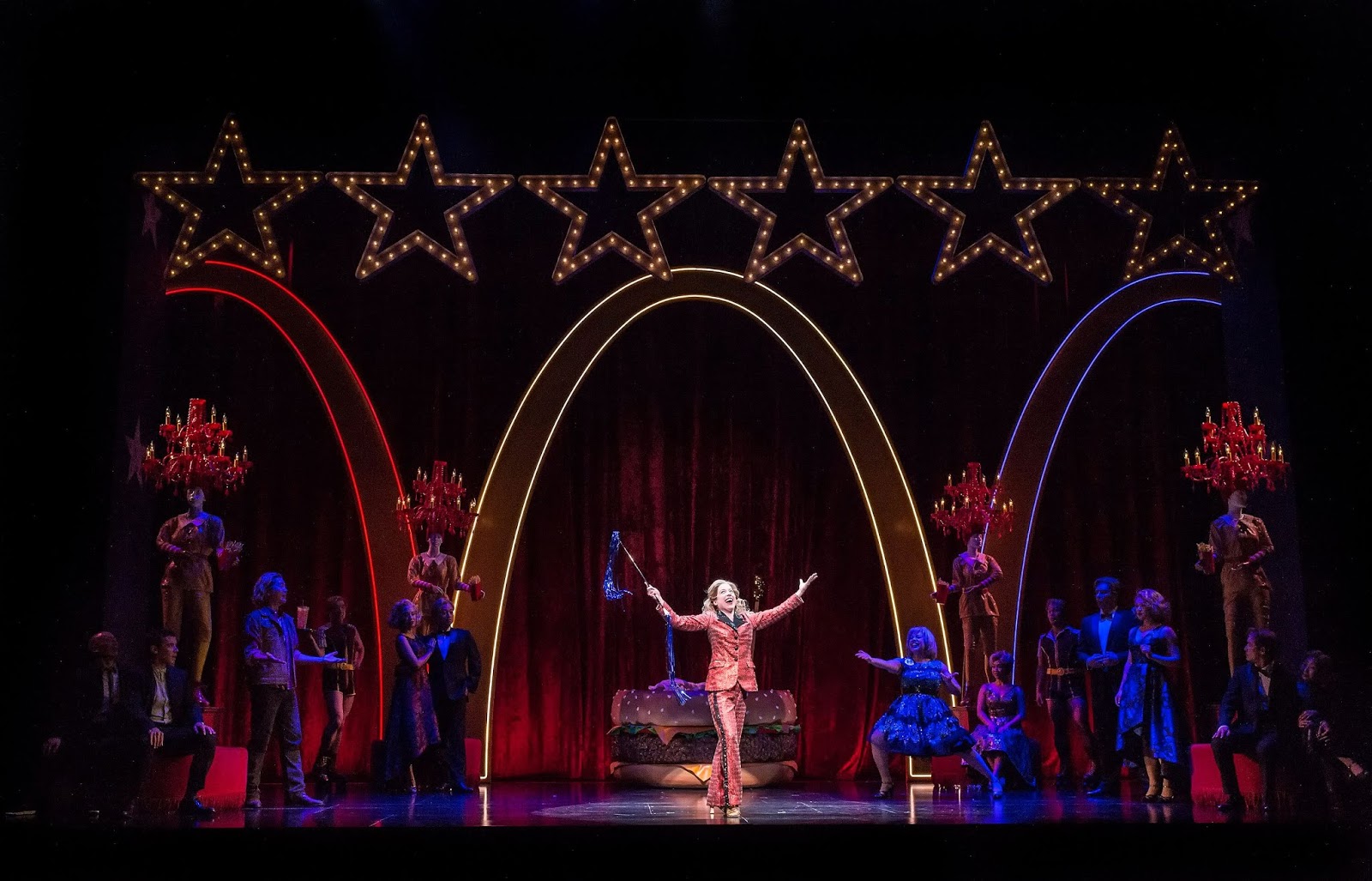
DHH (Francis Jue, center) talks to his friend Xue Xing (Conrad Ricamora, left) at an elegant 22nd century McDonald's.

Those roars rising from the Curran are reactions to “Soft Power,” the David Henry Hwang play with music and some lyrics (in addition to Hwang’s) by Jeanine Tesori.

Set in Hollywood in this century before advancing to Shanghai about 100 years from now, it’s full of issues that have evoked enormous concern in this country, especially in liberal areas like San Francisco.

It all starts with a writer called DHH (Francis Jue plays this stand-in for Hwang) working with a Chinese studio head, Xue Xing (Conrad Ricamora), on a TV show to be set in China.

Since it’s shortly before the 2016 election, they go to a Hillary Clinton (Alyse Alan Louis) fundraiser at a theater where “The King and I” is playing. Xue meets her on his own, and the two click.

After the election, Xue has a hard time understanding democracy, saying the Chinese system is more efficient.

Then DHH is stabbed near his home in Brooklyn (such an attack actually happened to Hwang), probably by a racist. He goes to the hospital and has a dream about a Chinese musical, “Soft Power,” based on his experiences. Soft power refers to a country’s culture, art and ideas as opposed to the hard power of its military might and economic strength.

This musical is shown in Act 2, which takes place in the 21st century, when it has become a Chinese classic and China has superseded the United States in soft power after being mostly its equal in hard power.

This is where it resonates so strongly with songs like “Good Guy With a Gun,” taking place in the White House and satirizing America’s permissiveness about guns.

It also imagines a relationship between Xue and Hillary and includes a short dance just like the one for Anna and the King of Siam (“Shall We Dance?”) in “The King and I.”

As directed by Leigh Silverman, the show fields a triple-threat cast of mostly Asian Americans who act, sing and dance well (choreography by Sam Pinkleton).

Alyse Alan Louis reappears as Hillary Clinton in a 22nd century musical.
The songs are terrific, too, such as Hillary’s “Song of the Campaign Trail,” which brought the opening night audience to its feet at the end of Act 1.

Music director David O conducts the large orchestra. Chris Fenwick is music supervisor.

The show is full of laughs, many of them emanating from the current political climate.
David Zinn’s set facilitates easy scene changes. One of his more impressive coups is the elaborate McDonald’s, which has become the best restaurant in Los Angeles in the 22nd century.

Costumes by Anita Yavich, lighting by Mark Barton and sound by Kai Harada add to the enjoyment.

This world premiere is co-presented by the Curran and Center Theatre Group, which staged it in Los Angeles in May.

Assuming it goes on to Broadway, it’s sure to be a strong contender for Tony Awards.

Running about two and a half hours with one intermission, “Soft Power” will continue through July 8 at the Curran, 445 Geary St., San Francisco.

For tickets and information, call (415) 358-1220 or visit www.sfcurran.com.

(Photos by Craig Schwartz Photography)

Thursday, June 21, 2018

Family reunion goes awry in 'Straight White Men'

Brothers Matt (Ryan Tasker, left), Jake (Seann Gallagher) and Drew (Christian Haines) celebrate Christmas Eve.

According to playwright Young Jean Lee, if you were born white and male, you already have an advantage over other people. If you’re straight, you have yet another advantage.

She explores these advantages in “Straight White Men,” presented by Marin Theatre Company.

The men of the title are a widower and his three adult sons who celebrate Christmas in the family home.

Matt (Ryan Tasker), the oldest son, already lives there with their father, Ed (James Carpenter). Despite an impressive resume, Matt holds only temp jobs at humanitarian organizations. He has never been married and has no girlfriend.

Drew (Christian Haines), the youngest, is a teacher and novelist. He has a girlfriend.
In the middle is Jake (Seann Gallagher), a banker who’s divorced from his black wife. They have two children.

At first, the get-together is marked by jokes and horseplay. Christmas Eve dinner is Chinese takeout eaten at the coffee table in the living room.

That’s when things go awry as Matt begins to cry. Over most of the rest of the play, his brothers and father try to figure out what’s wrong.

Because therapy helped him, Drew says Matt should see a therapist. Jake says Matt needs to present himself more positively to get a better job. 

Ed, the father (James Carpenter, left), asks Matt (Ryan Tasker) about student debt.
Ed says Matt is burdened by student loan debt.

They all seem to imply that being straight white men obligates them to meet certain standards.

As for Matt, he doesn’t agree with them, but he can’t be more specific about his goals other than wanting to be useful. He feels he’s doing that with his job and the help he gives Ed around the house. In the end, it’s not clear what he’ll do.

As directed by Morgan Gould, the cast is terrific with each man creating a believable character.

Two other characters, Person in Charge 1 (J Jha) and Person in Charge 2 (Arianna Evans), aren’t so believable. Except for a prologue by Jha, they’re essentially stage hands observing most of the action.

Both dance to the deafening rap music (sound by Sara Huddleston) that assails the audience before the show.

The inviting set is by Luciana Stecconi, lighting by Heather Basarab and costumes by Fumiko Bielefeldt.
Despite the inconclusive ending, “Straight White Mem” is enjoyable and thought-
provoking.

It runs about 90 minutes without intermission and will continue through July 8 at Marin Theatre Company, 397 Miller Ave., Mill Valley.

For tickets and information, call (415) 388-5208 or visit www.marintheatre.org.

Photos by Kevin Berne


Tuesday, June 19, 2018

Hilarity reigns in 'The Man Who Came to Dinner'

Mr. and Mrs. Stanley (Todd L. Summers and Jennifer Ellington) complain to their rude, wheelchair-using guest, Sheridan Whiteside. (Photo by Joyce Goldschmid)

Sheridan Whiteside is “The Man Who Came to Dinner” and stayed and stayed, causing major disruptions and leading to laughs galore.

Palo Alto Players is staging a humorous production of this nutty 1939 comedy by George S. Kaufman and Moss Hart.

It’s set in the small town of Mesalia, Ohio, shortly before Christmas in the late ’30s. Sheridan (James Shelby) was to attend a dinner party at the home of Mr. and Mrs. 
Ernest Stanley (Todd L. Summers and Jennifer Ellington). Just as he was going in, however, he slipped on some ice and broke his hip.

Consequently, he’s confined to a wheelchair in the Stanley home, which he has taken over. He constantly insults his hosts as well as his doctor (Tim Farrell) and nurse (Roneet Aliza Rahamim).

Only some household help, his stream of guests and his longtime secretary, Maggie Cutler (Kristen Lo), escape his vicious tongue.

When Maggie falls in love with a local newspaper reporter, Bert Jefferson (Paul Dunlap), and seems likely to leave her boss, he tries to thwart the romance. He summons his friend and notorious vamp, Lorraine Sheldon (Athena Rink), to town to woo Bert away from Maggie.

Whiteside is reportedly based on Alexander Woollcott, a famous theater critic who had his own radio show. In the play, Whiteside is on a first-name basis with Hollywood and Broadway stars as well as world leaders.

Directed by PAP artistic director Patrick Klein, the large cast includes several actors connected to Palo Alto schools, mainly Gunn High, where Shelby is the theater director and teacher.

The acting is uneven, but several performances stand out, including Shelby’s as Whiteside and Lo’s as Maggie. 
Also noteworthy are Brian Flegel as actor Beverly Carolton and Chris Mahle as Banjo, another actor friend. Banjo, who seems based on a Marx brother, has a hilarious scene in which he pretends to fight off an attack by Lorraine’s fur stole.

Complementing the production are the set by Nikolaj Sorensen, lighting by Isaiah Leeper, costumes by Mary Cravens and sound by Danielle Kisner.

Running about two hours and 45 minutes with two intermissions, “The Man Who Came to Dinner’’ will continue through July 1 at the Lucie Stern Theater, 1305 Middlefield Road, Palo Alto.

For tickets and information, call (650) 329-0891 or visit www.paplayers.org.